The story on stage
Buddha's Light: lotus, tree and karma
What the Buddha's Light stage show stages in Luang Prabang: the falling lotus, the sacred tree, the Buddha's light, karma and rebirth, explained.
Book your seat ↗Quick answer
Buddha's Light tells one story of heaven, earth and living beings: a lotus flower falls, a sacred tree emerges, the Buddha arrives and teaches, and beings move from confusion toward awakening. The show draws on Buddhist classics and Laotian folklore, and its themes are compassion, karma and reincarnation. No knowledge of Buddhism is needed, but a few symbols make the evening easier to read.
The shape of the story
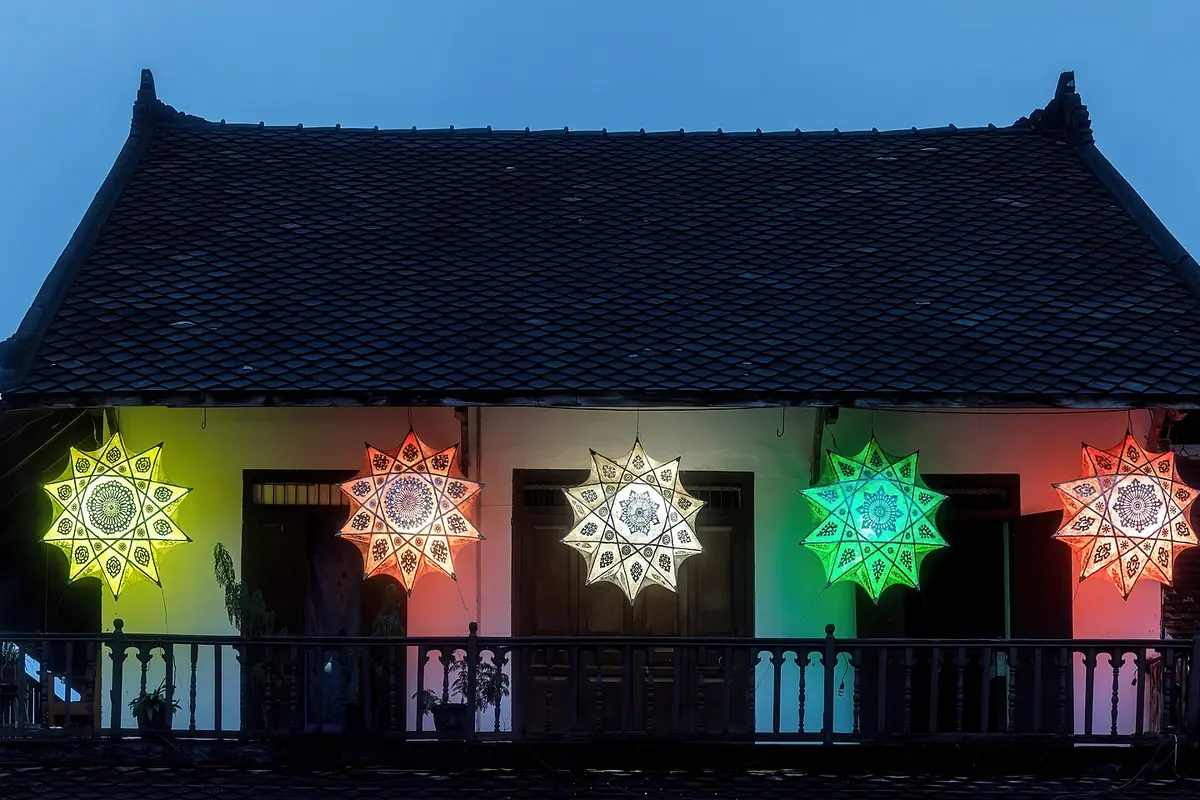
The show begins with heaven, earth and all living things, from the falling of a lotus flower and the emergence of a sacred tree. It then tells of the Buddha's arrival on earth and his teachings, and of mythological legends. The plot depicts the cause and effect between good and evil in the human world, the confusion and awakening of beings, and the Buddha's compassion and wisdom guiding humanity toward enlightenment.
The lotus
In Buddhist art the lotus is an ancient symbol of purity, detachment and fertility. The Buddha is compared to a lotus, which comes up from muddy water unstained, in the same way that he rises above the world's defilements. The lotus is also another symbol for the Buddha and his awakening. A flower that falls at the start of a story about awakening is a clear sign of where the story is heading.
The sacred tree
The best-known sacred tree in Buddhism is the Bodhi tree, a sacred fig of the species Ficus religiosa. Bodhi means awakening or enlightenment, and tradition holds that Siddhartha Gautama reached enlightenment around the fifth century BCE while seated beneath a Bo tree at Bodh Gaya. The fig, with its heart-shaped leaves, has come to symbolise wisdom and spiritual awakening. The show's sacred tree has its own staging, and the Bodhi tree is useful background.
The Buddha's light
In the show, the Buddha's light symbolises wisdom, compassion and purification, and it implies the dispelling of darkness and the illumination of the soul. That is why light is one of the show's four stage arts, alongside dance, music and drama. Light and imagery do the work that narration would do in a play, so watch how a scene changes when the light does. Among Buddhist symbols, the dharma wheel is one of the earliest and stands for the Dharma, the Buddha's teaching. You can see dharma wheels on the ceiling of the sim at Wat Xieng Thong, in the town itself.
Karma, in brief
In the Buddhist tradition, karma refers to action driven by intention that leads to future consequences, and the word literally means action. The Pali texts quote the Buddha as saying that intention is kamma. That is why the show sets out the cause and effect between good and evil: what a being intends shapes what follows. Intention also shapes the kind of rebirth a being takes, and Peter Harvey, quoted on Wikipedia, puts it plainly: actions must be intentional if they are to generate karmic fruits. It is a theme to watch for, and not a lecture you have to follow.
Samsara and rebirth
Samsara is the beginningless cycle of repeated birth, ordinary existence and dying again, perpetuated by desire and ignorance. It ends when a being attains nirvana, the extinction of desire and the acquisition of true insight into the nature of reality. The show speaks of the enlightenment and growth of sentient beings in samsara, so the awakening of the beings on stage is the story's turning point. Theravada Buddhism, the main form in Laos, treats the cycle of rebirth as something a being can leave through insight into impermanence and non-self.
Before you go
A performance of this kind asks little of you. It is a cultural and spiritual performance and not a religious service, no prior knowledge of Buddhism is required, and it suits all ages. Read the lotus, the tree and karma once, then let the dancers and the light carry the evening. The booking guide covers the seating areas, pickup and what comes with each seat. The farewell song and dance after the show is optional, so you can leave your seat or join the circle.
Read next: Buddha's Light show: tickets and areas
Frequently asked questions
Do I need to know Buddhism to follow the show?
No. No prior knowledge of Buddhism is required, and the show is a cultural and spiritual performance and not a religious service.
What does the lotus mean in Buddhism?
It is an ancient symbol of purity and a symbol for the Buddha and his awakening, because it comes up from muddy water unstained.
Which tree is sacred in Buddhism?
The Bodhi tree, a sacred fig, under which tradition says Siddhartha Gautama reached enlightenment.
Sources